
The most-quoted 2026 rent cap number in the Bay Area is not the one that applies to most rent-controlled buildings. Under California's statewide Tenant Protection Act (AB 1482), the maximum allowable annual rent increase for covered units in the San Francisco–Oakland–Hayward region is 8.8% for the period running August 1, 2026 through July 31, 2027 — but a large share of older Bay Area apartment buildings sit under a local rent ordinance that caps increases far lower, often between 1% and 5%. For an owner deciding how much to raise rent this year, the first question is not "what does the state allow," but "which rule actually governs my building."
Key takeaways
- AB 1482's 2026 statewide cap is 5% plus regional inflation, not to exceed 10%. In the San Francisco–Oakland–Hayward area (San Francisco, Alameda, Contra Costa, Marin, and San Mateo counties) that works out to 8.8% for August 1, 2026 through July 31, 2027; in Santa Clara County it is 8.6%.
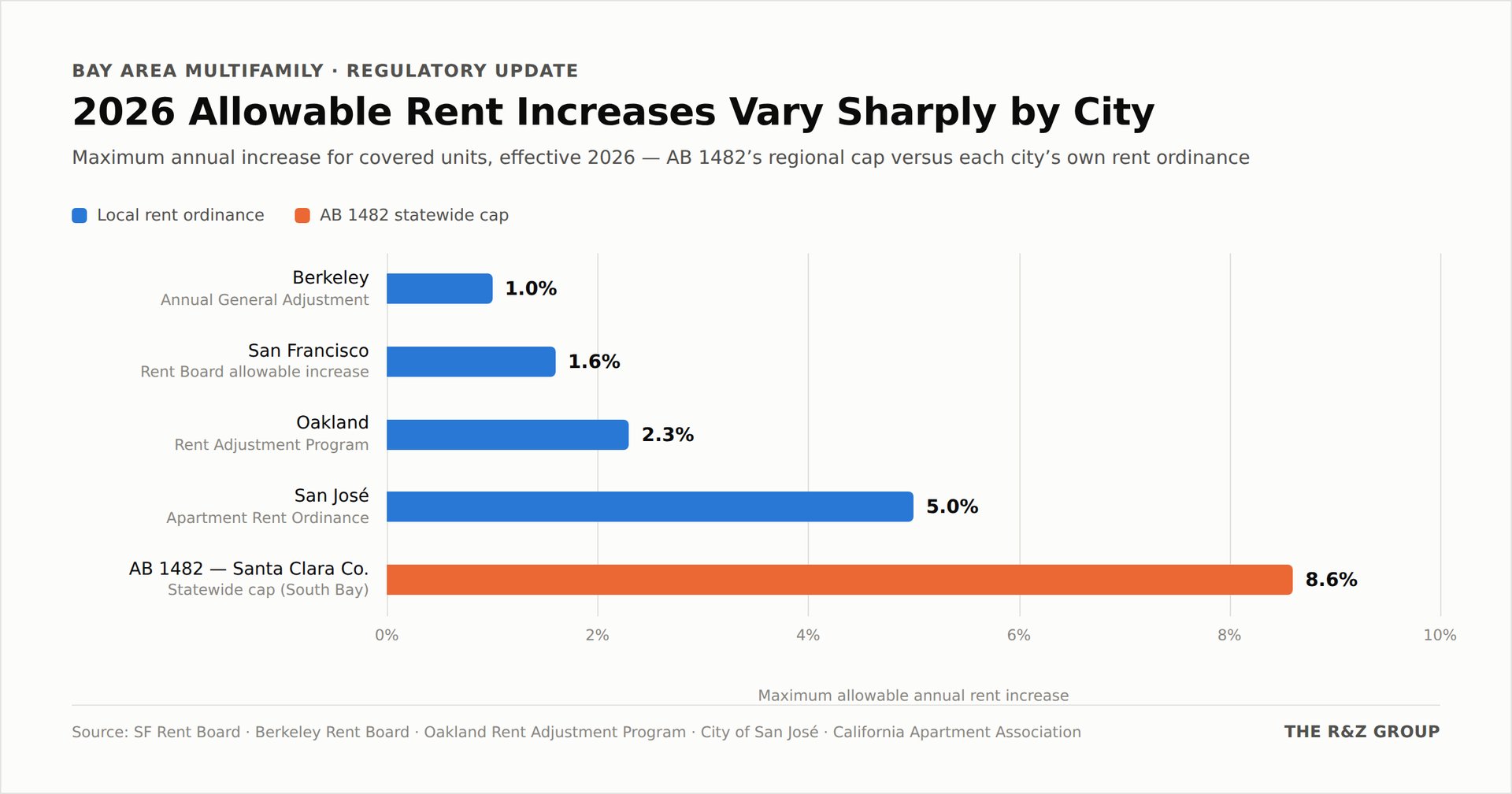
- Where a city has its own rent ordinance, that local cap usually controls and is much lower: San Francisco is 1.6%, Berkeley is 1.0%, Oakland is 2.3%, and San Jose's Apartment Rent Ordinance is a flat 5%.
- Local caps apply mainly to older buildings — for example, apartments built before mid-1979 in San Francisco and before September 1979 in San Jose — while newer construction is typically governed by AB 1482 or exempt entirely.
- Several property types are exempt from AB 1482, including most single-family homes and condominiums, buildings issued a certificate of occupancy within the last 15 years, and some owner-occupied duplexes.
- Applying the wrong (higher) cap is one of the most common and costly compliance mistakes for small owners, and AB 1482 is currently scheduled to remain in effect through 2030.
What AB 1482 caps in 2026, and how the number is set
AB 1482, the California Tenant Protection Act of 2019, limits annual rent increases on covered units to 5% plus the regional change in the Consumer Price Index (CPI) — a standard inflation measure — with a hard ceiling of 10% no matter how high inflation runs. The percentage resets each year based on the prior spring's CPI reading for each region.
For the current period, the CPI adjustment in the San Francisco–Oakland–Hayward region came in at 3.8%, producing an 8.8% cap (5% + 3.8%). Santa Clara County, which covers San Jose and most of the South Bay, uses a 3.6% CPI figure for an 8.6% cap. These caps took effect August 1, 2026 and run through July 31, 2027.
Two details trip owners up. First, the increase is measured against the lowest rent charged in the prior 12 months, not simply the current rent. Second, the cap is per 12-month period, not per calendar year, so the clock runs from each unit's most recent increase. AB 1482 also carries a "just cause" eviction standard for covered tenancies, generally once a tenant has occupied a unit for 12 months (or 24 months where multiple tenants are involved).
Why the local number usually wins
California allows cities to keep or adopt their own rent-stabilization ordinances, and where a local rule is stricter than AB 1482, the local rule generally governs the units it covers. That is where the 8.8% figure becomes misleading, because the Bay Area's largest rental cities cap increases well below the state ceiling. AB 1482 functions as a statewide floor of protection for units that are not already covered by a tougher local law — not as the operative number for a rent-controlled building in San Francisco or Oakland.
The practical effect: an owner of a 1920s fourplex in San Francisco is not working from 8.8%. They are working from the San Francisco Rent Board's allowable increase, which is a fraction of that.
What this means in each Bay Area sub-market
San Francisco. The San Francisco Rent Board's allowable annual increase is 1.6% for the period March 1, 2026 through February 28, 2027 — set at 60% of the regional CPI change. This applies to units under the city's rent ordinance, generally apartments in buildings first occupied before mid-1979. Newer buildings and most single-family homes and condos fall outside local rent control and are instead governed by AB 1482 or exempt.
East Bay. Oakland and Berkeley each run their own programs. Oakland's Rent Adjustment Program set its allowable increase at 2.3% for August 1, 2026 through July 31, 2027. Berkeley's Annual General Adjustment is 1.0%, effective January 1, 2026. Both apply to older covered units; buildings and unit types outside those programs default to AB 1482's 8.8% regional cap. East Bay cities without their own ordinance rely on AB 1482 directly.
South Bay. San Jose's Apartment Rent Ordinance caps increases at a flat 5% per 12-month period for covered apartments — buildings of three or more units first built and occupied before September 7, 1979, roughly 38,000 units citywide. Apartments and cities in the South Bay that fall outside that ordinance are covered by AB 1482, which puts the Santa Clara County cap at 8.6%.
Peninsula. Most Peninsula cities do not have their own general rent-stabilization ordinance, so AB 1482's 8.8% regional cap is typically the operative limit for covered units — with local exceptions (East Palo Alto, for instance, runs its own rent-stabilization program). Owners on the Peninsula should confirm their specific city's status before assuming the state cap applies.
Which properties are exempt from AB 1482
Not every rental is covered. The most common exemptions include buildings that received a certificate of occupancy within the previous 15 years — a rolling window, so a 2011 building becomes covered in 2026 — and most single-family homes and condominiums, provided the owner is not a corporation, real estate investment trust (REIT), or an LLC with a corporate member, and the owner delivers the required written exemption notice. Owner-occupied duplexes and deed-restricted affordable units are also generally exempt.
A related state law, Costa-Hawkins — the 1995 statute that limits how far local rent control can reach — is what keeps single-family homes, condos, and most post-1995 construction out of local vacancy control and lets an owner reset rent to market when a unit turns over. It works alongside AB 1482 rather than replacing it, which is part of why the coverage question is genuinely case-by-case.
For most small owners, the takeaway is not to memorize every exemption but to confirm, in writing, which framework applies to each specific unit before issuing a rent increase notice — and to keep the exemption notice on file where one applies.
Frequently asked questions
How much can a landlord raise rent in the Bay Area in 2026? It depends on the building. Under the statewide AB 1482 cap, covered units in the San Francisco–Oakland–Hayward region can rise up to 8.8% for August 1, 2026 through July 31, 2027, and up to 8.6% in Santa Clara County. But units under a local rent ordinance are capped much lower — 1.6% in San Francisco, 1.0% in Berkeley, 2.3% in Oakland, and 5% in San Jose. The local cap generally controls where it applies.
Does AB 1482 or the local rent ordinance apply to my building? Where a city has its own rent-stabilization ordinance and it is stricter than AB 1482, the local ordinance generally governs the units it covers — typically older buildings, such as those built before mid-1979 in San Francisco or before September 1979 in San Jose. Buildings and unit types outside the local ordinance fall under AB 1482, and some properties are exempt from both.
Is my rental exempt from AB 1482? Possibly. Buildings issued a certificate of occupancy within the last 15 years are exempt on a rolling basis, as are most single-family homes and condos not owned by a corporation, REIT, or corporate LLC (with proper written notice to the tenant), owner-occupied duplexes, and deed-restricted affordable housing.
When did the 2026 rent caps take effect? The AB 1482 regional caps took effect August 1, 2026 and run through July 31, 2027. San Francisco's 1.6% runs March 1, 2026 through February 28, 2027; Berkeley's 1.0% took effect January 1, 2026; Oakland's 2.3% runs August 1, 2026 through July 31, 2027.
How long will AB 1482 remain in effect? As currently written, AB 1482 is scheduled to remain in effect through 2030.
This post is for general information and is not intended as legal advice, tax advice, or financial advice. Confirm how these rules apply to your specific property with your attorney or a qualified property manager before issuing any rent increase.
Sources: SF Rent Board · Berkeley Rent Board · City of San José · California Apartment Association · Fast Eviction Service calculator · All East Bay Properties · Coastline Equity · Mynd